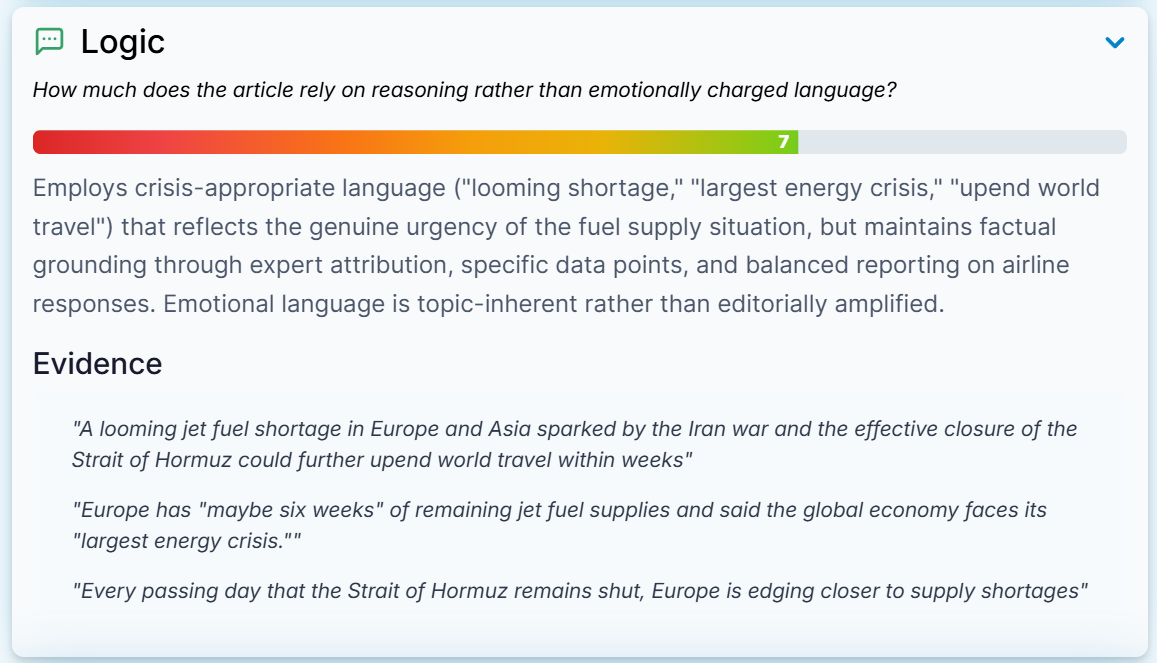
What it teaches: Low sourcing is not always a red flag. Context across the full profile tells the real story.
Both good and bad breaking news have low Evidence and low Sourcing. But everything else diverges. The bad article compensates for thin sourcing with emotional activation, directional framing, false precision, and selective context. The good article compensates with measured tone, honest uncertainty, and internal coherence.
In breaking news, judge the article not by what it knows but by how it handles what it does not know.
What it teaches: Precision is not the same as proof. Specific-sounding language is one of the most effective credibility signals an article can manufacture.
The signature is high Specificity paired with low Evidence. Numbers, names, and precise language create an impression of rigor. But underneath, the claims lack verifiable grounding. Consistency is high because it is constructed, not reported.
The more specific an article sounds, the more carefully you should ask whether that specificity is grounded. Precision is easy to manufacture. Verification is not.
What it teaches: Emotional activation and directional pressure together are the signature of content designed to move people, not inform them.
Logic and Autonomy are both low. Emotional language dominates and only one acceptable conclusion is presented. Facts may be present but in service of the emotional narrative. Nuance is absent because complexity would interrupt the emotional momentum.
When Logic and Autonomy are both low, ask what the article wants you to do. Because it wants you to do something.
What it teaches: A perfectly coherent article can still be a narrow one. Consistency is not a substitute for completeness.
This is the pattern that feeds algorithmic reinforcement. It feels credible because it never contradicts itself, but only because it never introduced anything that would. One perspective dominates throughout. Tone is often measured. Direction is embedded in the framing, not the tone.
Ask not whether the article holds together but whether it ever introduced anything that could complicate it. An article that never challenges its own premise is not rigorous. It is selective.
What it teaches: Well-attributed quotes from a single perspective is still one-sided journalism. Attribution is not balance.
This is the most sophisticated pattern because it passes every basic credibility check a reader would run without a framework. Sourcing is high — named, credentialed sources. The article looks rigorous. But Balance is low. Only one side's complexity is explored. Only one side's sources are sought.
Before you trust an article because it is well-sourced, ask whose sources they are. Attribution tells you where the information came from. Balance tells you whose information was sought.
What it teaches: Clear-Sight does not detect AI authorship. But AI-generated content tends to exhibit a specific construction pattern — high surface credibility with low depth underneath.
The signature is a cluster of high surface signals — Specificity, Consistency, Logic — combined with low depth signals — Nuance, Context, Evidence. The article feels complete. It reads smoothly. Nothing jars. But when you look for genuine complexity, genuine tension, genuine depth of context, it is not there.
The question is not whether an article was written by a machine. The question is whether the article has the depth that genuine reporting produces. High surface credibility combined with low depth is the pattern worth learning to recognize.